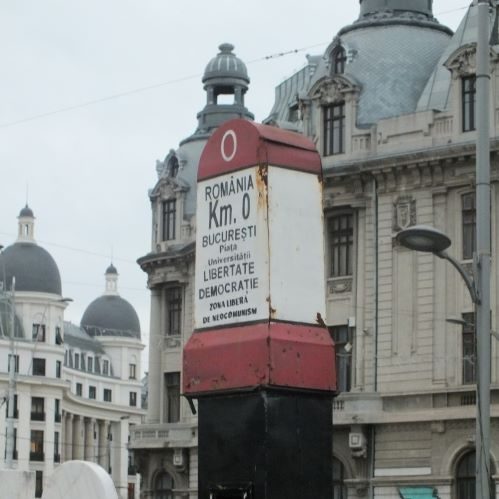
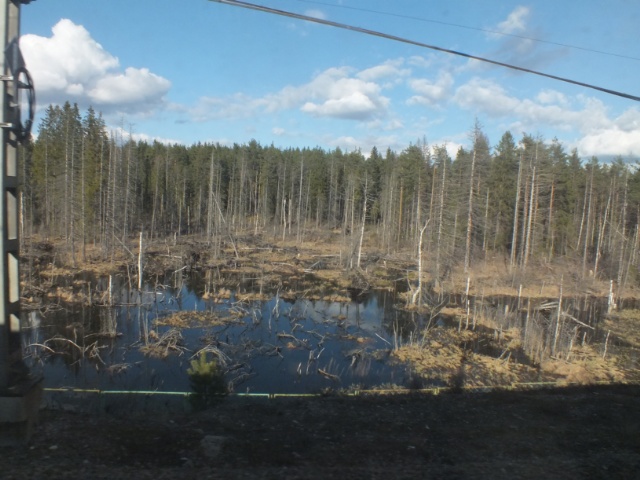
The train from St Petersburg to Moscow served as good practice for the Trans-Mongolian, though next time I won’t have the luxury of a four-person compartment. We travelled past forest in a straight line for nine hours.
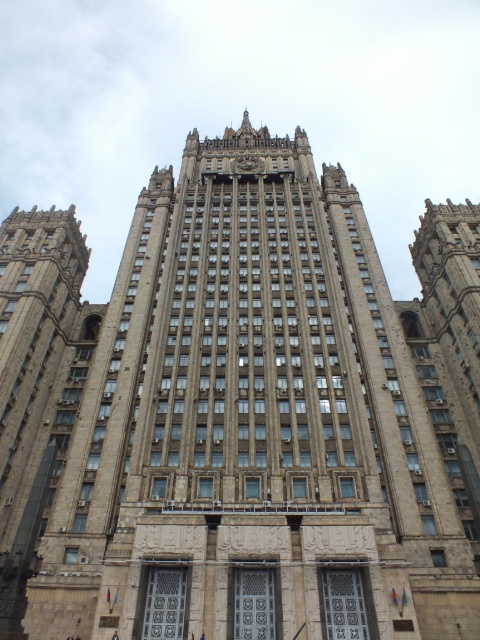
Whereas St Petersburg is the cultural heart of Russia (so I was told), Moscow is the financial heart – and you can feel the difference. Moscow is not pretty or particularly beautiful, though there are few nice streets and squares, but it does have certain buildings that stand out. The Ministry of Foreign Affairs, for instance, is a spectacularly grim tower.
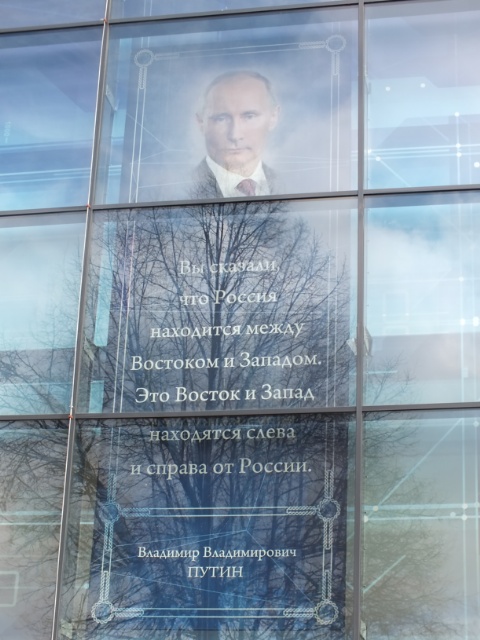
Everyone morning I pass the walls of the Kremlin and see dark cars entering or leaving, and with the souvenir shops selling mugs and t-shirts with Putin’s face on, I feel myself drawn into the Putin cult. A rather sombre counterpoint to this is the great shrine to Boris Nemtsov on the bridge where he was killed. It was something of a surpise then when I went inside the Kremlin, and it didn’t feel like we were anywhere near the political heart.
The armoury is a treasure chest – coronation robes, the real Monomakh’s cap with sable fur and gold filigree, huge ornate wooden carriages the size of lorries, and faberge eggs (including one of the trans-siberian railway!).
The main attractions were the icons and churches. There were some extraordinary ones, many of them famous, and with wonderful names – the Saviour of the Fiery Eye, the Saviour of the Fierce Eye, the Saviour Not Made With Hands, and my favourite, the Saviour with Golden Hair.
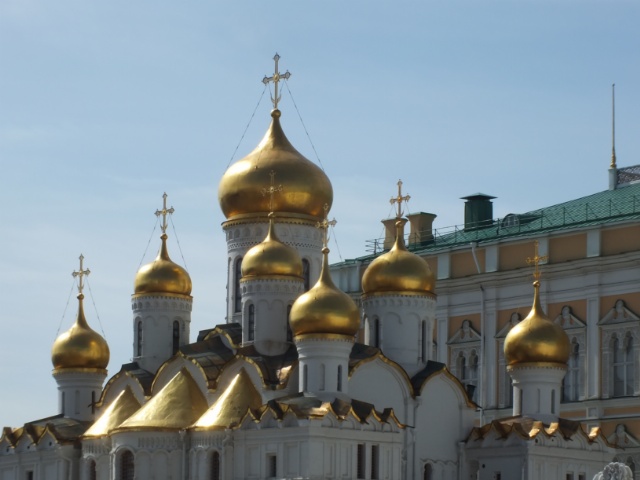
Seeing Rublev’s icons was definitely the high point. They were beautifully simple, and sometimes on an enormous scale, and they have aged well – the colours haven’t really faded, and the tones haven’t been lost – it’s just a few fragments that have artfully flaked away. I went on a final trip to the Museum of the Russian Icon (which is free, “in order to encourage interest in the subject”, and is the consequently the only museum that has a decent toilet) and saw a ‘Master’ at work in his studio. He did some things slightly differently from what I’m used to, like adding vinegar to the egg mixture, then grinding the egg with the powder for up to 20 minutes, and then painting the gesso a pale brown before starting so that the bright white doesn’t affect the colours or the Master’s perception of them. And he preferred linseed oil to yacht varnish!

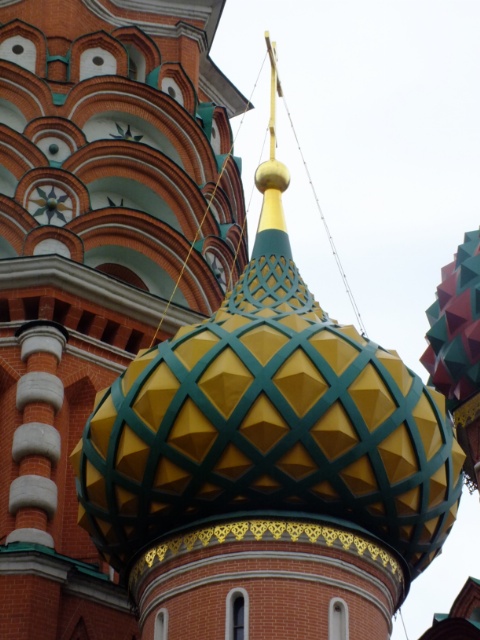
St Basil’s Cathedral, the image of Moscow I suppose, is of course beautiful. Inside was not what I was expecting at all – it is a maze of thick frescoed walls, linking a lot of dark, smaller churches together into a warren. As I climbed the stairs, the sound of singing drifted down, and when I reached the top I saw a choir was singing and the whole church had stopped, completely entranced by this heavenly scene.
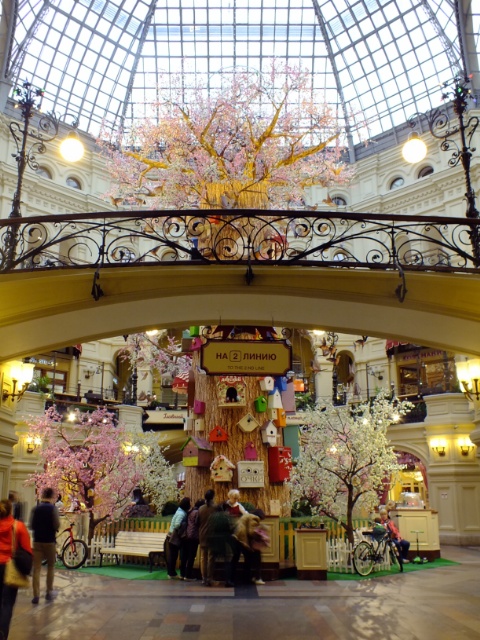
Coming back down to cobbled earth, spring is at last arriving here. The leaves are nearly out, the fountains are being tested, and everything (everything) is being repainted. In fact, Moscow has pre-empted nature by creating an artificial spring: there are arches of plastic flowers in the squares, giant metal easter eggs with plastic butterflies, and in GUM (the state – now main – department store, famous for being expensive) there are cherry trees in blossom and bird song is piped through the speakers over opera singing while everyoone walks around eating ice cream.
I am reading Master and Margarita and so went to Bulgakov’s house, where there is a tram slicing off the head of Berlioz and, rather alarmingly, a large black cat. I then thought it appropriate to go and read at Patriarch’s Pond, where the devil first appears. The spirit of the devil appears to still be there, because when I got up I realised that all the benches were still wet with paint and my bottom was now bright yellow. Everyone else had made the same mistake and was now trying to discreetly inspect their rears in shop windows. Over the next few days I saw several people in the street with smears of yellow paint.

When I told my Moroccan dormitory neighbour about this, he shook his head and said that wasn’t the devil, and had I actually seen the devil? We then argued and watched numerous videos of exorcisms and people writhing around in agony as the Qur’an was read aloud. This was all in French, and my Russian has since been utterly confused. (I have also met some students from Chechnya, who explained what the various republics of Russia were, and a Belarussian student, who talked a great deal about life in Europe’s last dictatorship).
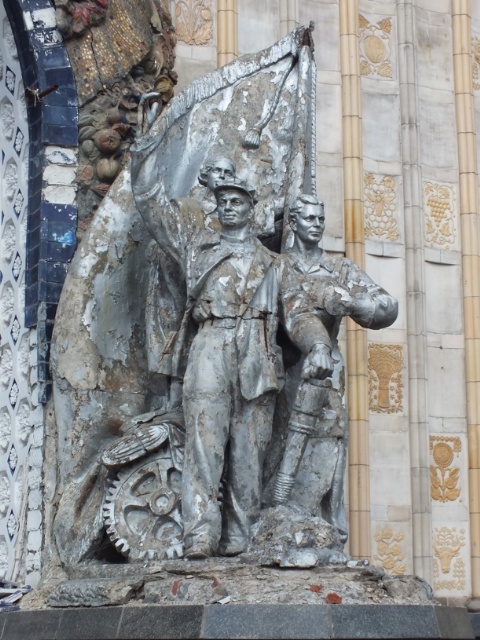
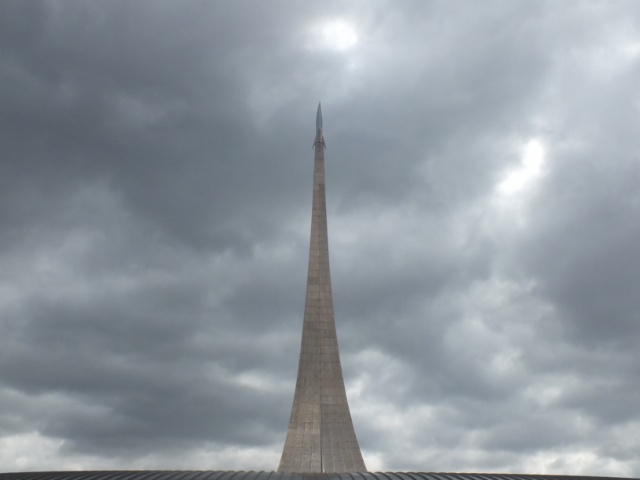
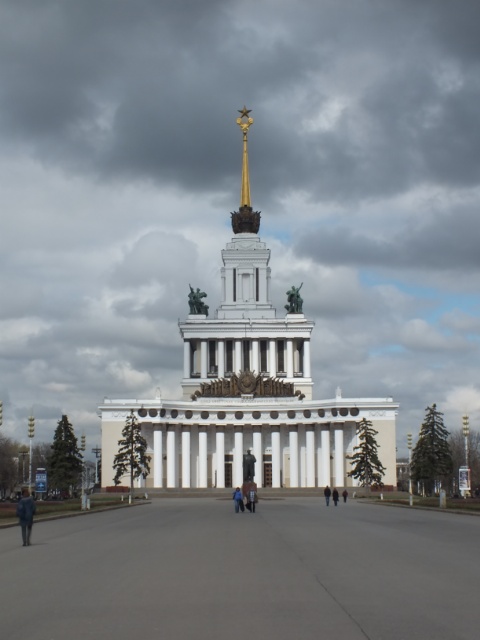
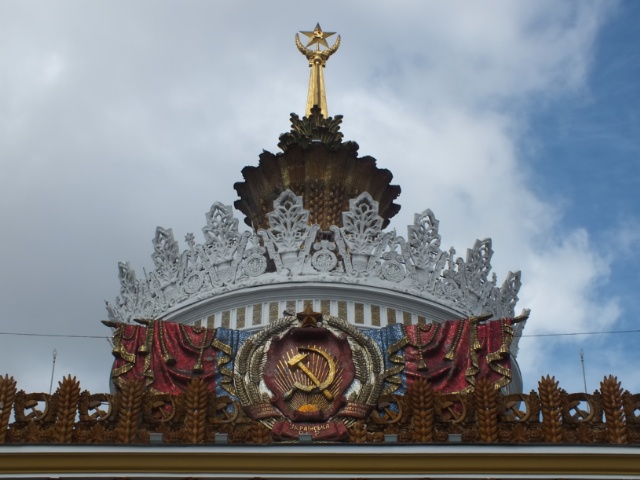
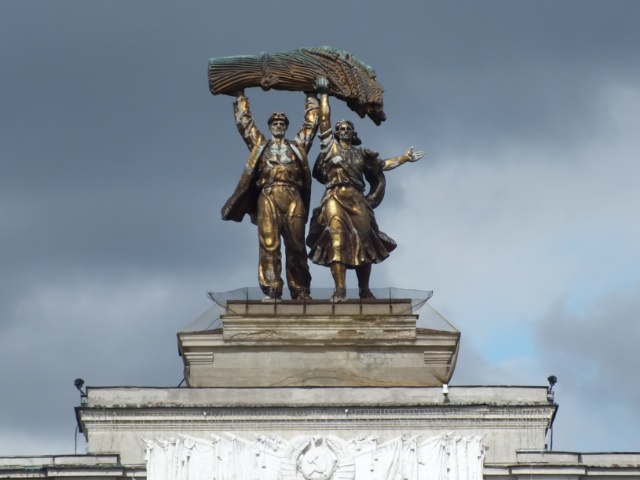
The last part of Moscow I visited was VDNKh, or the Exhibition of the Achievements of the National Economy, which is now a kind of Soviet theme park. Among the hundreds of buildings, there are various temple-like structures dedicated to each of the Soviet Republics, a pavilion of Consumer Cooperation, and a Fountain of National Friendship. Music is played all day long, people go to rollerblade and eat ice cream, and thousands of people are employed to sweep the streets and polish the fountains. This crubling park may have inadvertantly succeeded in creating a happy Russia. But behind the main avenue are abandoned streets of bungalows, rotting buildings and bakeries, deserted honey shops, and suddenly it all seems slightly too sinister.
I’ve enjoyed my week in Moscow. It’s a hipster (or as they say here, ‘gipster’) city, full of coffee shops, glossy 4x4s, policemen hanging around, people walking their dogs on hoverboards, children and tourists practising their goose stepping, Soviet souvenir shops and street signs that don’t even make sense to Muscovites. I’ve paid my respects to my literary heroes and made my pilgrimage to the icons I so wanted to see.
Moscow is eternally busy, a city for living in and doing things, for writing epic novels and organising revolutions. As a humble tourist, I feel welcome, but a little out of place.

 Km. 0
Km. 0 