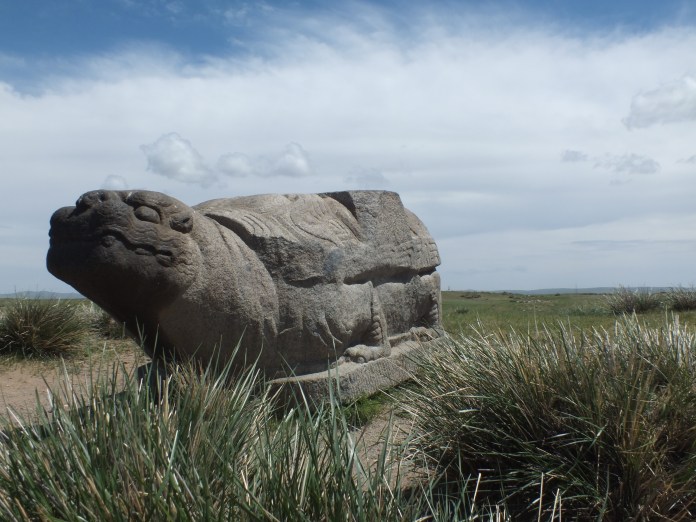
At Kharkhorin, all that can now be seen of the city that was, briefly, the capital of Mongolia is a monastery complex and some stone turtles. The wind blew hard and the prayer flags flew upwards, arching towards the sky. Inside a ger three little boy monks chanted while another monk performed a ceremony for a couple.
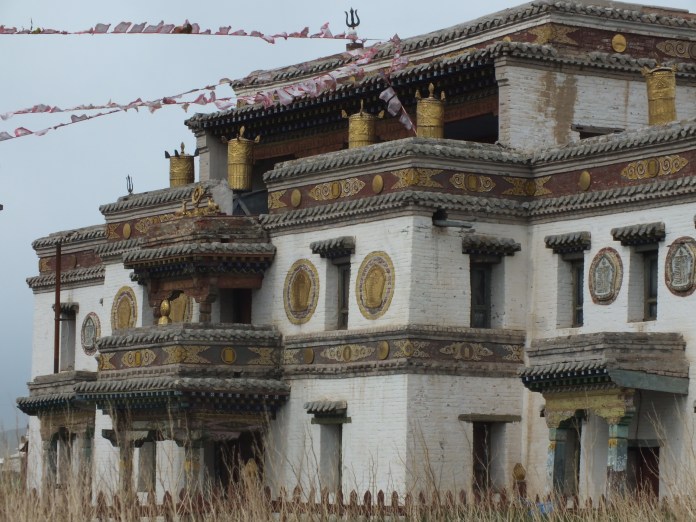
I tried as unobtrusively as possible to join a tour group as the guide explained some of the statues and things in the temples (I know NOTHING about Buddhism I realise). Like the story of the only female dharmapala who killed and ate her son who was turning evil like his father, and now keeps her good son in a bag; she was chewing on her son and her horse was riding on his flayed skin – quite terrifying.
The owner of my Guesthouse arranged for me to go on a six day trip to see a waterfall and to ride to the Eight Lakes, guided by his uncle, a nomad herder, and staying with nomadic families. A very ordinary tourist activity, but no evidence of signs to accommodate tourism. Shar, my guide, knew about four words of English, and otherwise we communicated by gesture. He, along with everyone else I met on the way, wore the traditional del – a long coat which fastens diagonally from the neck, with a colorful piece of cloth tied around the waist. He was 55 but looked about 70. The first morning we sat in his ger eating yak yoghurt and waited for him to cut up all his cigarette papers, and then we set off.

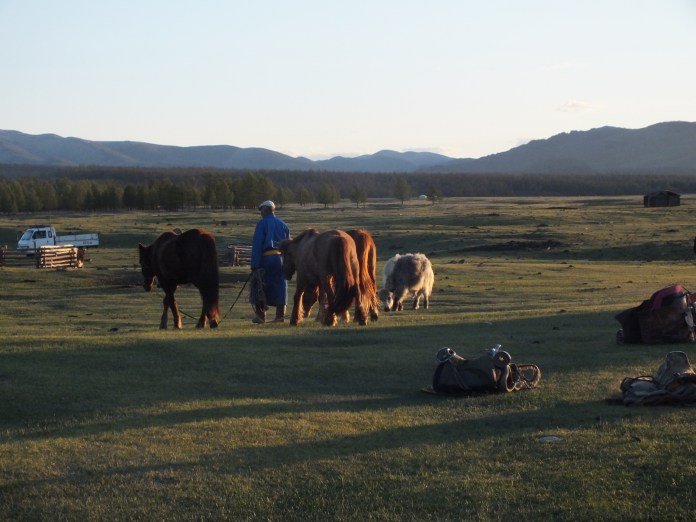
The horses did not like being tied up, and the luggage horse was particularly disgruntled at being made to carry my backpack, and he kicked and reared and neighed. But Mongolians start riding pretty much from birth, and Shar was able to control the horses effortlessly, just making a few noises and turning the horse around – it was extraordinary to watch. I didn’t have the chance to practice riding beforehand since Shar hadn’t managed to catch the horses in time, but I’d been told the only word was ‘chu’ – go. But no matter how many times or ways or pitches or volumes I said it, my horse wouldn’t budge faster than a crawl, so I spent the first day being pulled along like the incompetent tourist I was. Later, I picked up some of the nuances – choh, chhhu, cha. (Later on the return drive, I heard our driver willing the car to ‘chu’ up a steep hill). As we rode, Shar would play music on his phone, or he would sing or whistle, always the same slow, high-pitched, meandering Mongolian songs.
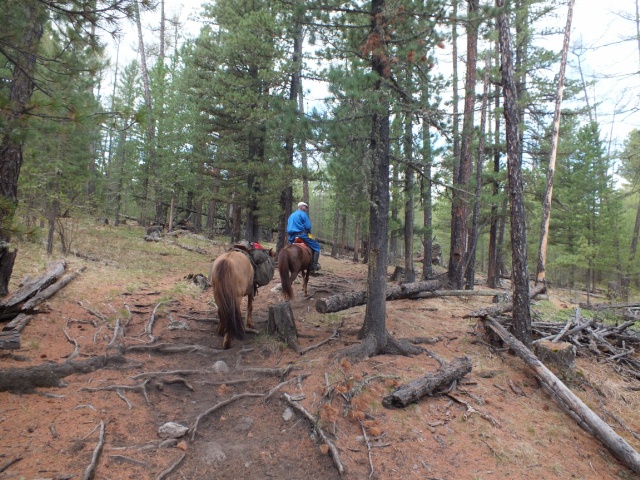
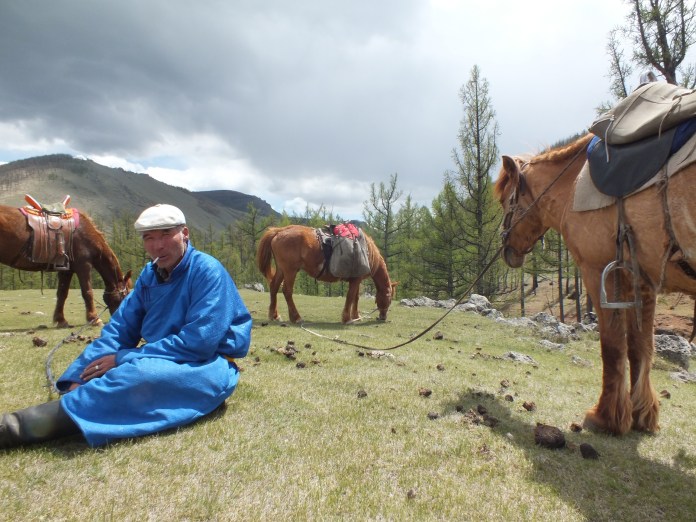
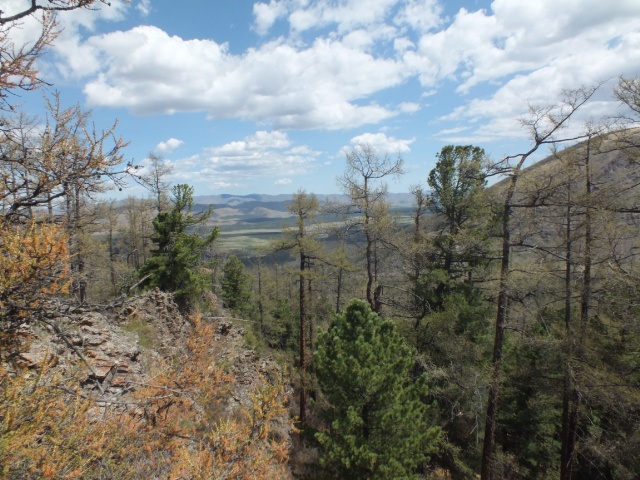
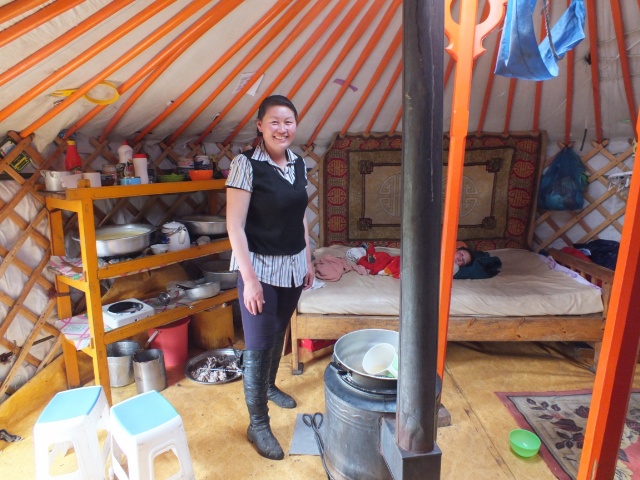
Now is the high time for moving down to the summer camp, and we saw yaks loaded with gers and their furniture. It takes about an hour to set up the summer ger. The families I stayed with and their gers were traditional, and remarkably similar. Most of the children were away at school so it was just the older ones and a few babies and toddlers. Some of the gers had wooden floors while others were built directly onto the earth, with grass coming up the sides of the plastic floor, and the holes would be sellotaped up in the evenings. There would be a shrine at the back, next to which would be a little TV and a phone tied to the ceiling.
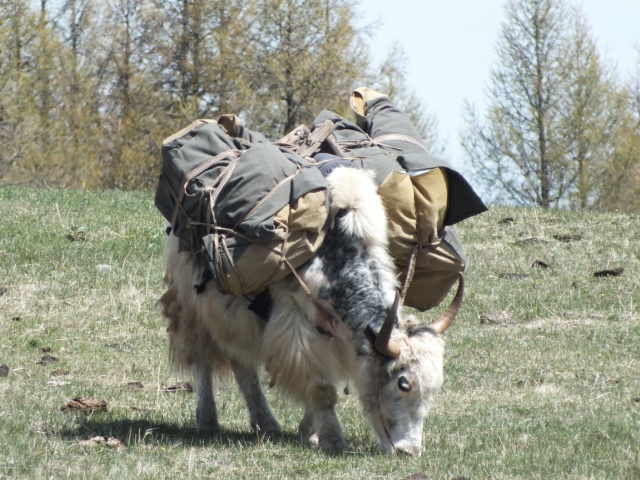

When we arrived (no knocking, you just walk in and sit down), we were given bowls of salty milk tea, and a big bowl of yak cream, which was like an enormous plate of clotted cream an inch thick. You would have a teaspoon of it and pass it to your neighbour. They would then cook you a meal which would begin by getting out a dark brown shrivelled lump like a rotten carrot – dried yak – and hammering it on a stone; this was then soaked or boiled. There were only two meals: yak with rice or yak with noodles. The noodles would have to be made each meal time by kneading the dough, rolling it out, drying it on the fire and then cutting it up. There was never a table – it was all done on one of the beds.

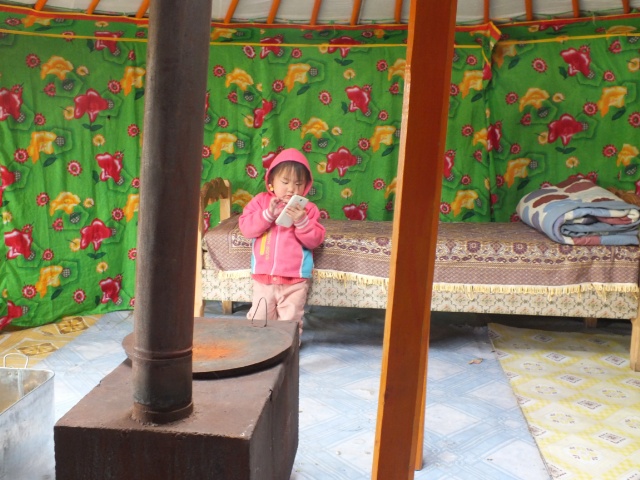
On one occasion the family killed a sheep, and we were given a large basin filled with entrails and an enormous knife and dagger. Shar cut it up and passed me the warm (thankfully cooked) pieces to eat for what felt like a (not altogether unpleasant) age. I could only recognise the intestines and the heart, maybe the liver as well.
There were large plastic barrels which I at first took to be holding water, but were in fact full of yak yoghurt. This ranged from the wonderfully mild to the almost fizzy. Never, ever, was there a vegetable or piece of fruit. I was completely stuffed the entire time as they always filled me a bowl that was twice as big as anyone else’s. Food took up a lot of time in the day.

Nowhere in any of my preparatory reading did anyone mention that airag, the fermented mare’s milk for which I had specially come to Mongolia, is not made all year round. It is too cold at the moment, and all the animals are at their weakest. But I was more than happy with the yak milk. In the evening we would sit and watch the animals or watch TV. It’s a quiet life (at the moment), and every day was pretty much the same. I felt quite embarrassed to be sitting there watching them as though I had come to a zoo. I didn’t want to snap away at them, so most of my photos are of yaks and goats. But I was relieved that I had gone on my own when I saw the way some other tourists behaved on a later occasion.

On the final day of riding we had to take a mother and baby yak to another valley. Whenever we passed a herd of yaks they would rush over, and Shar would canter off with his stick shouting ‘hoch’ (I never saw anyone gallop – perhaps because it’s the weak time of year), and I, having no control over my horse, would follow through bushes and trees, jumping over rocks. It was very funny and sweet, and by the end we just had to walk at a tired baby yak speed.

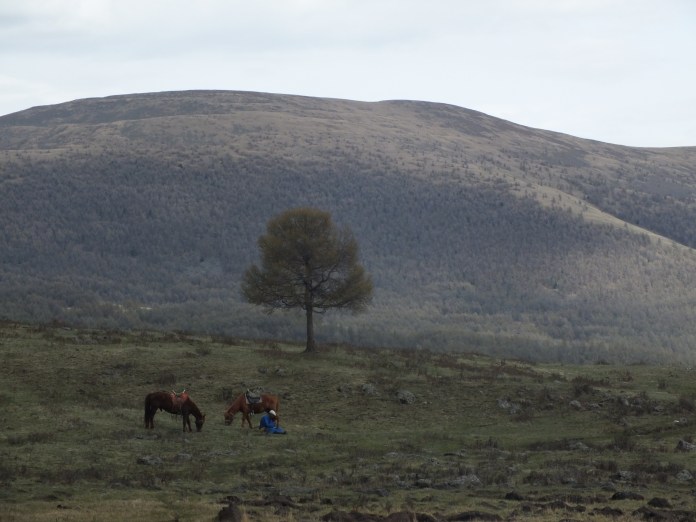
Returning to Ulaanbaatar was dirty and unpleasant. I wanted to be back in the open, trotting across the steppe, eating dried yak and yoghurt, watching the stars from my bed as the saddles glowed in the firelight.




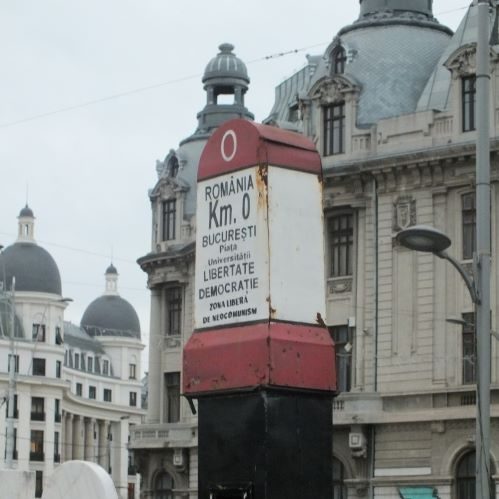
 Km. 0
Km. 0 
Once again Iona fabulous pictures and a fascinating narrative! Your journey looks so interesting but I’m not sure about the food or the lack of comforts but then you are young and brave !
I’m just resting after a busy day shopping and lunching in St.Tropez.
Looking forward to my children and 10 week old granddaughter arriving tomorrow.
I look forward to further blogs from you , I’m following your journey with great interest.
Very Best Wishes,
Carole 🇫🇷🍾🍷
LikeLike