I arrived in Almaty on a dark, rainy night and took an unmarked taxi to the hostel where I’d arranged to meet my sister. A Kazakh man was climbing the gloomy staircase, carrying, he told me, beer for us. Sophie had befriended the entire hostel and everyone seemed to know who I was. Around midnight we headed off to the next door Turkish-Russian-Kazakh restaurant to meet her friend Yusuf, and then came back for beer with Ilya, the Jazz flautist from the staircase. The following day we were booked in for Yusuf’s English lesson, given by Gulya who lived in our dormitory.
We were the only tourists in the hostel: most people had moved to Almaty for work and were living there indefinitely. Ilya had spent his first three days living in Almaty train station before finding a barista job, which paid $7 a day (that’s almost as much as we were paying for a night in the hostel). When we turned in at 3am, he said he wasn’t able to go to sleep because he wouldn’t be able to wake up in time for work at 7am. I never saw him again.
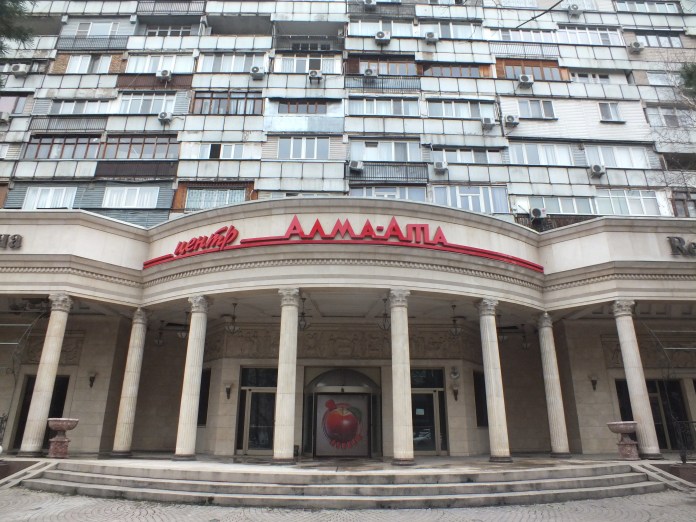
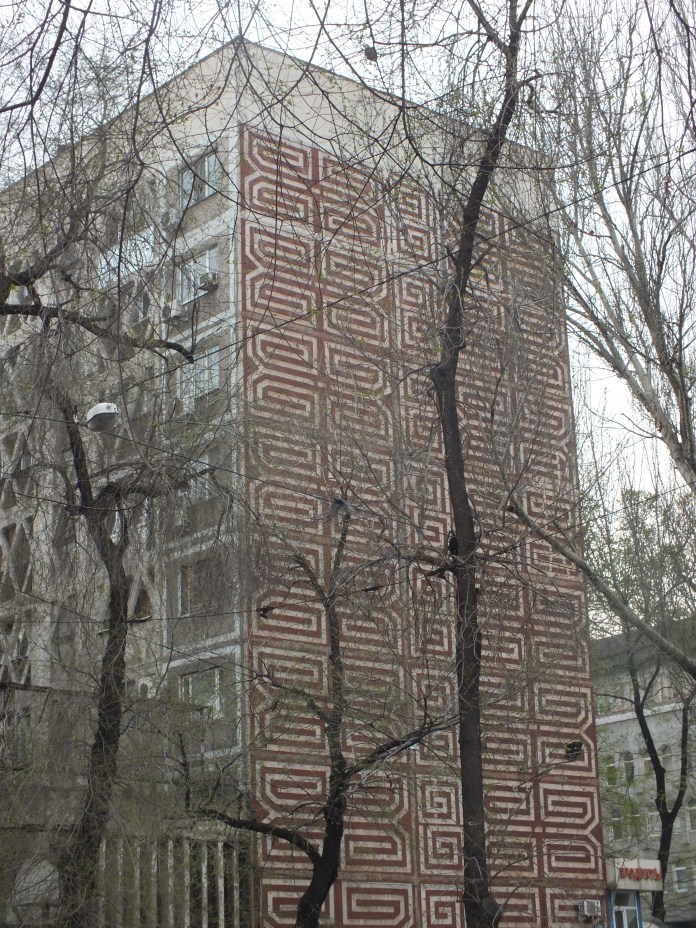
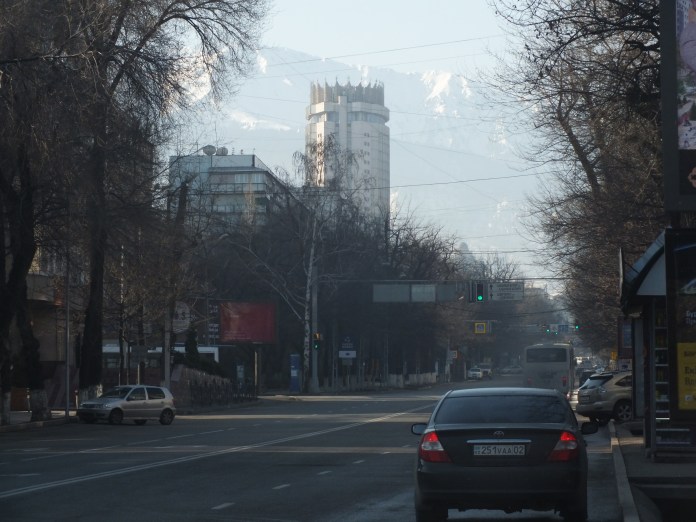
By daylight I was surprised at how pleasant a city Almaty is. There is a surprisingly large amount of surviving Tsarist architecture: small, pretty, pink and green buildings with white ornamentation that make you think of dolls houses or castles in winter wonderlands. Even the Soviet-era blocks have simple bits of decoration that give them individual character and make any walk varied and interesting. What could be a grey concrete grid of a city is in fact a pleasant network of streets, almost always tree-lined, and often with pedestrianised side-streets linking the wide, busy avenues with grand views into the mountains.
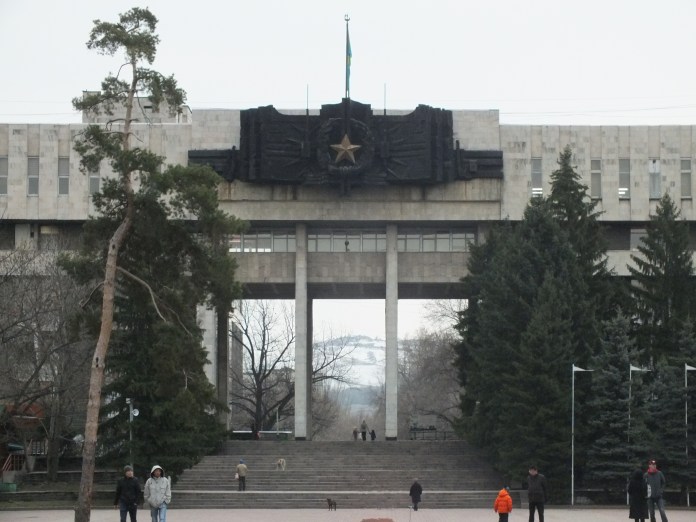
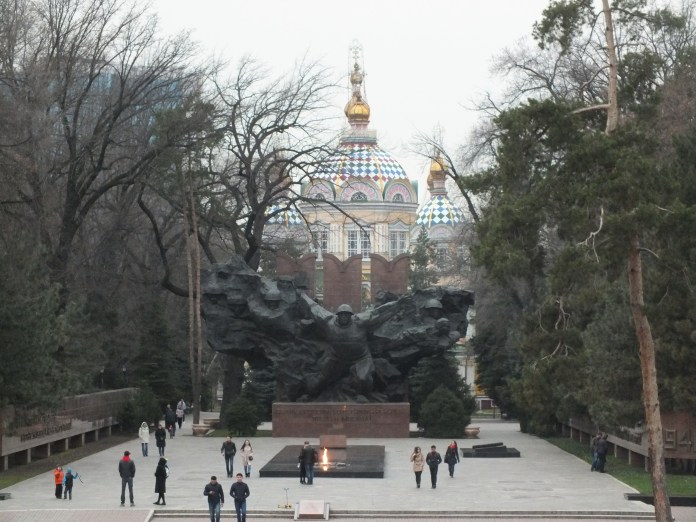
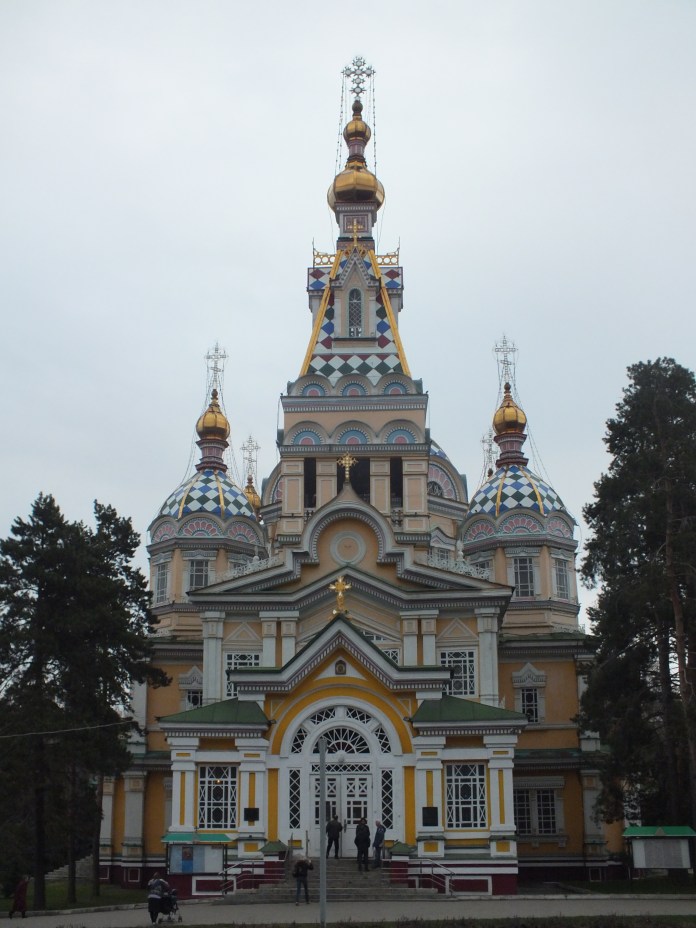
In the centre of Almaty lies Panfilov Park, which is dominated by a large Russian Orthodox cathedral made entirely of wood and painted in bright colours. A terrifying Soviet war memorial looms out over passers-by behind the cathedral (which thankfully overshadows the sculpture). It depicts the Panfilov heroes, three times larger than life and with impossibly chiselled cheeks and muscles. The accompanying quote glorifies Moscow and is a reminder of just how Russian Almaty can feel, with its banyas, blinnayas, ballet and borsch. In fact, there is even concern about the survival of the Kazakh language because Russian is so widely used. But I wasn’t expecting Almaty to also feel so European, to have so many dainty little cafes, American films and western luxury brands. It all feels a very long way from the once nomadic life of the steppe.
We decided to go to the opera house, an ornate and gilded building where all the workers were dressed in smart blue and gold trouser suits. I do not understand how it is possible for one nation to produce so many beautiful and glamorous women – it made me feel very ridiculous and inferior, sitting on my little blue and gold chair in walking boots and a fleece. Our tickets for Birjan and Sara, a traditional opera about love between two dombra players, cost £2, but there were so few people that we were allowed to sit anywhere in the stalls we liked. Sara sang about Birjan, ‘my proud hawk, nightingale of the steppe’, and Birjan died surrounded by his three great loves: his mother, Sara (‘my steppe glow’), and his dombra (Kazakhstan’s national instrument, a traditional wooden two-stringed instrument). With his dying breath he sang a lament for his homeland and for his song that would live on in Kazakhstan. At the end the small audience all clapped in time together, a very sorry sight. But it was so much fun that we immediately bought tickets for the opening night of a ballet adaptation of Anna Karenina. The star of that performance was very much the three year old boy who stood on stage soaking up his applause, bowing grandly, admiring his new lego, who in the end had to be dragged off stage.

There are some good museums worth visiting in Almaty. The best is on Kazakh folk instruments, and it is housed in a wonderful old wooden building where you can listen to music played on the instruments. Other museums feel rather Soviet, with large empty marble halls, faded and dusty displays, attendants who tail you everywhere, and, invariably, photos of President Nazarbayev on the top floor, or even a whole exhibition on him if you’re lucky. But there were beautiful things: as a crossroads of the world since neolithic times, Kazakhstan has a fascinating archaeology and incredibly rich mix of cultures. There were fabulous ethnographic displays of traditional dress and yurts and, my favourite, a pair of enormous boots which looked just like a whole sheepskin wrapped around a foot.
We were wandering around the state art gallery, past paintings of eagle hunting and a very dashing Stalin, and found ourselves in a room of east Asian art. There was a TV crew set up and a producer came over, desperate for an interview with someone – anyone, apparently (though foreigners are always an excitement – in the whole week we were in Almaty, I could probably count the number of westerners we saw on one hand). Sophie neatly side-stepped the invitation by saying I would give an interview, so I went on Kazakh TV, reciting whatever the producer mouthed at me, saying how much I admired Chinese culture for having invented porcelain, gunpowder and paper.

On Easter night we went to the cathedral. As we approached Panfilov Park there were stalls selling circus toys, flashing balls and spinning toys thrown into the air, which gave the night a festival, even carnival, atmosphere. Hundreds of people were overflowing from the building and the service was being screened outside, while inside the priests would occasionally turn to the camera and shake incense at us through the lens. Everyone carried baskets with painted eggs and decorated kulichs, with candles which, when burned too low, would be removed from the kulich and stuck into the soil of the cathedral garden. Priests would regularly venture outside, accompanied by soldiers, to drench us in holy water, joining in everyone’s laughter as they did so.

In the early evenings of our wanderings through the streets and parks, we would catch tanatlising wafts of chocolate and caramel and roasted nuts. We couldn’t work out where it was coming from until our final day, when at last we saw the ‘Rahat’ chocolate factory right in the centre, the other side of the bazaar. It was with pride that the many generous people we encountered, who gave us lunch and fed us on countless occasions, would bring out ‘Rahat’ biscuits and chocolate. For all the deliciousness of Russian sweets, or even the sweet goodness of an Uzbek tomato or Georgian wine for that matter, nothing was better than the shy smile of a Kazakh offering us Rahat.



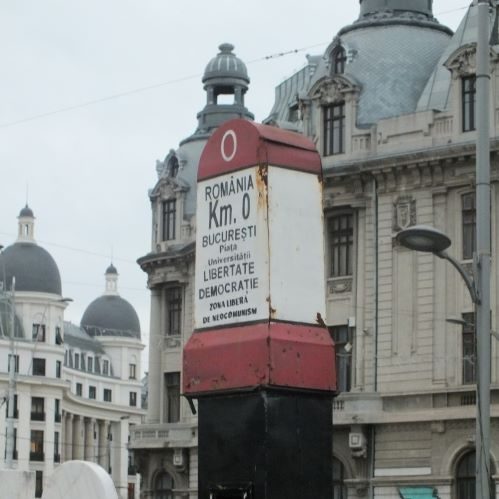
 Km. 0
Km. 0 