Shymkent has long been called the Texas of Kazakhstan, a wild place full of crime and gangsters where everyone and everything is out of control. It’s 11 hours from Almaty, but only an hour and a half from Tashkent in Uzbekistan. ‘Be careful,’ we were warned in Almaty, ‘they’re not friendly like we are here.’
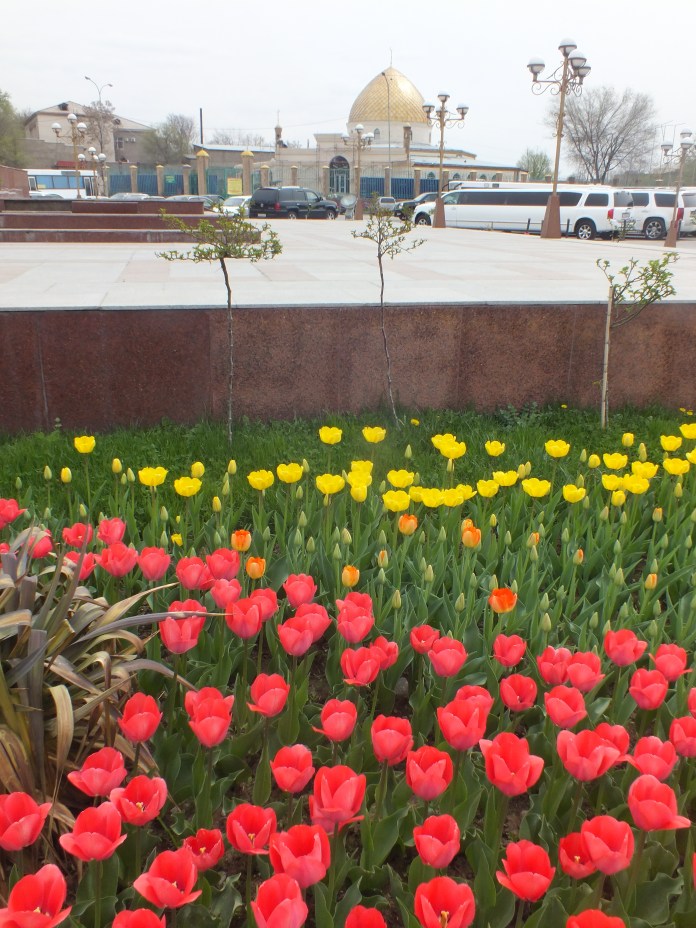
From the train we were met by our guesthouse owner, who offered to take us on a tour of the city. We were driven around night-time Shymkent, past the screams of a funfair, the mayor’s palatial official residence, and streets full of neon tulips (tulips, like apples, apparently originate from Kazakhstan).
‘What do they say about Shymkent in Almaty?’ he asked. An awkward silence. ‘You don’t need to worry about crime here. Everyone is much friendlier in Shymkent.’
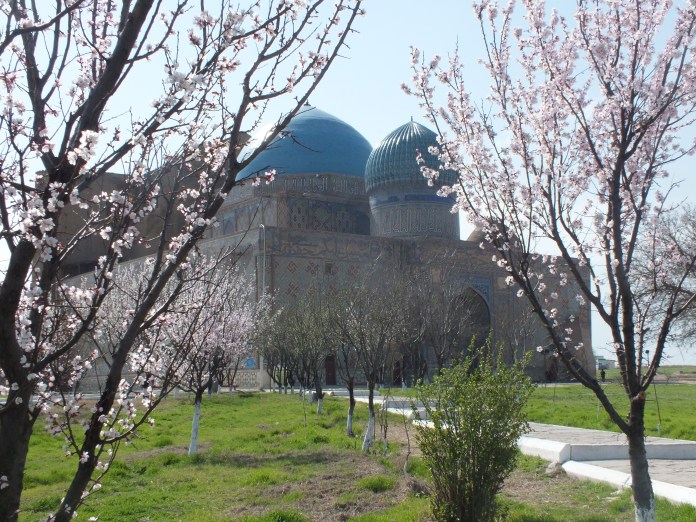
Southern Kazakhstan borders Uzbekistan and is in some ways closer to the settled culture of the Uzbeks than the nomadic life of Kazakhs. Unlike cities such as Almaty and Astana, which were largely built by Russian invaders, some of the towns in southern Kazakhstan still seem as though they belong to an ancient past. The most famous of these is Turkestan, which has been inhabited since the 4th century BC, but which became famous in the 14th century when Tamerlane ordered the building of a magnificent mausoleum to the sufi saint Khoja Ahmed Yassawi.

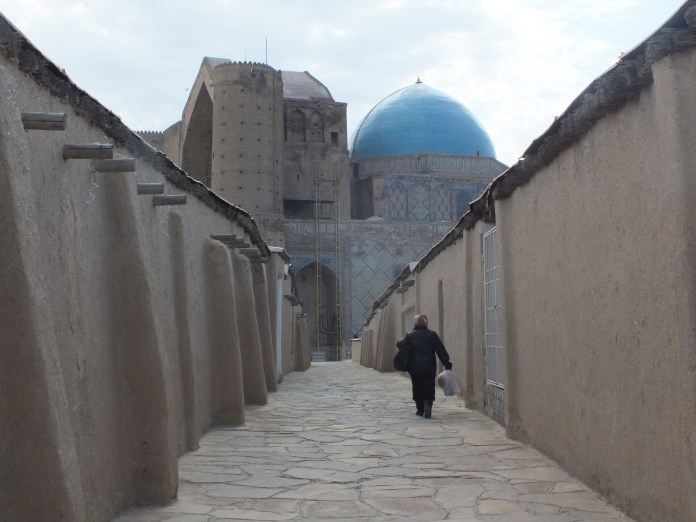
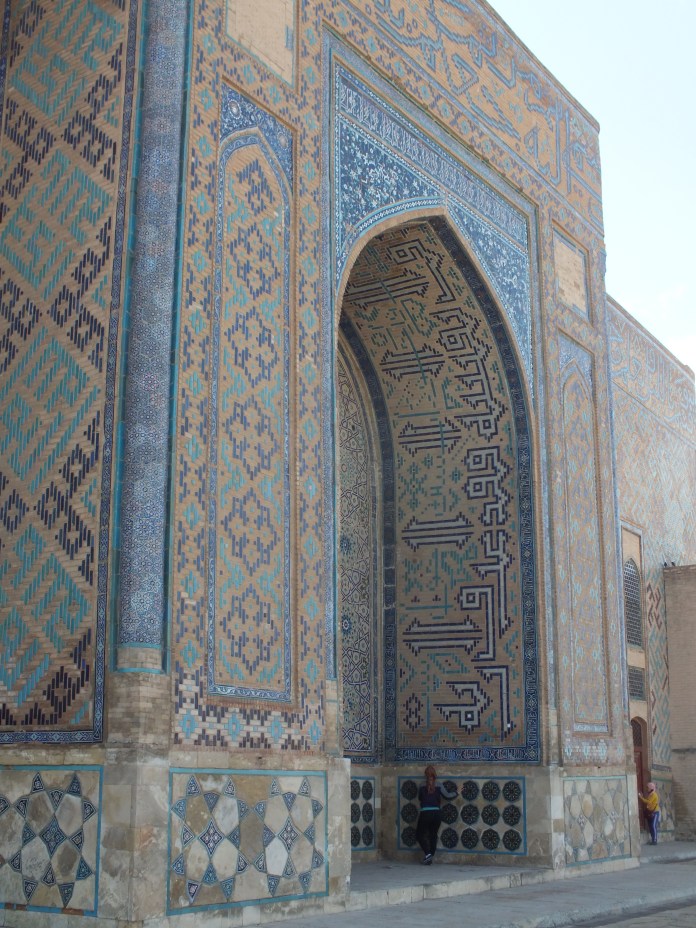
We reached the mausoleum through a stone archway and along a path lined with trees thick with blossom. From a distance, its colours looked dull, the air clouded by the dust that blows off the steppe. Close up, however, the tiled walls are bright and lively, exquisite in pattern and colour. Women walked slowly around the perimeter, both hands on the walls, head bowed, feeling their way as they prayed. Birds swooped in and out of their nests in the building, squeezing through the intricate geometric lattices. On the south-eastern side, the Mausoleum revealed its unfinished state: only bare brown brick remains, undecorated and with wooden beams still sticking out. It had a very different kind of beauty: austere, meditative, calm. This mausoleum is considered by some to be one of the three greatest pilgrimage sites of Islam, second only to the Haji (some even consider three pilgrimages here to be worth one pilgrimage to Mecca).
We found our way to the ticket kiosk and bought tickets at the rate for ‘citizens from the far abroad’. Inside the mausoleum was a large white hall with bare walls and scalloped ceiling, and a magnificent great cauldron in the centre, two metres in diameter and made of seven kinds of metal. Along a tomb-like corridor we found a wooden grille, through which we could see the green tomb of Yassawi. Pilgrims sat here on benches, praying and talking to family and friends.
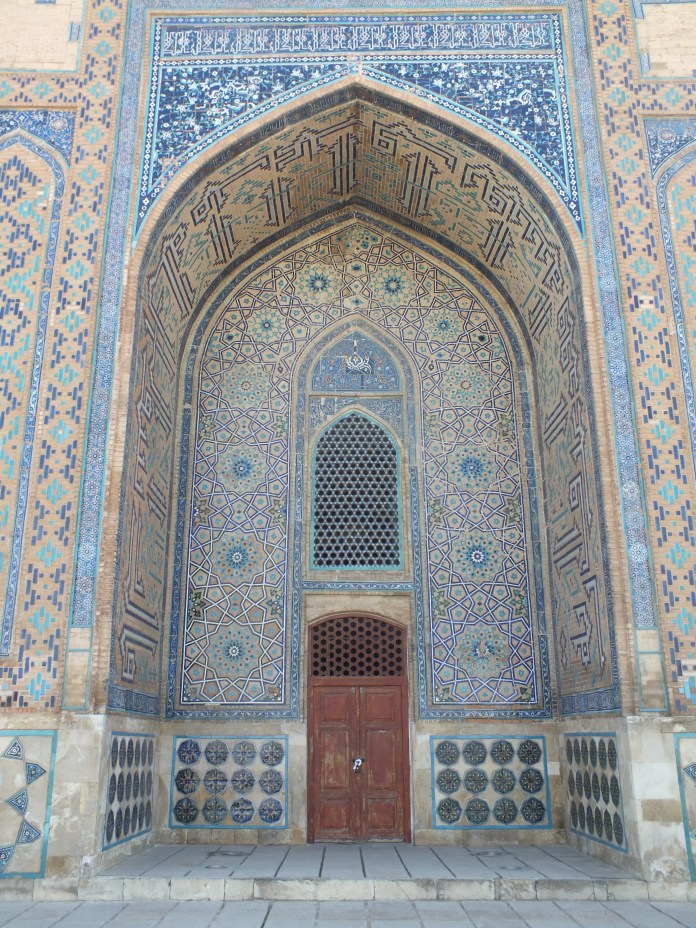


Surrounding the main mausoleum were mosques, smaller mausoleums for other holy people, and a bath house. As we were looking at an old wooden column carved with calligraphy, on top of which perched a pigeon’s nest with tiny chicks, a group of teenage boys came up to us. Without a word, they stood behind us and one held up his phone to take a selfie with us. They went off looking happy, taking more selfies in front of the old Qurans.
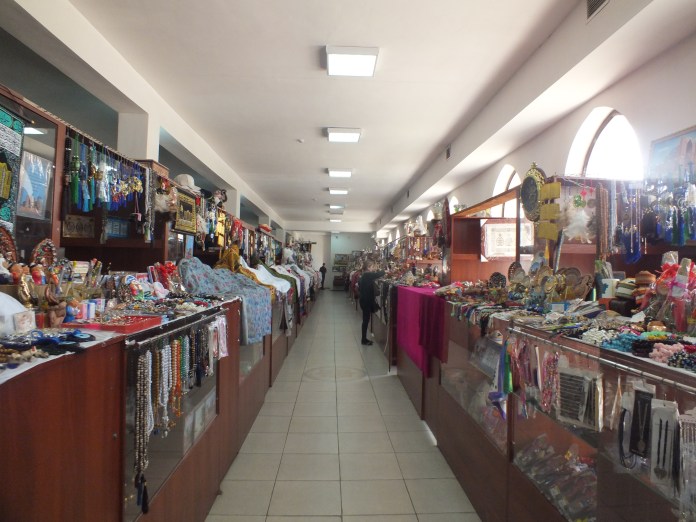
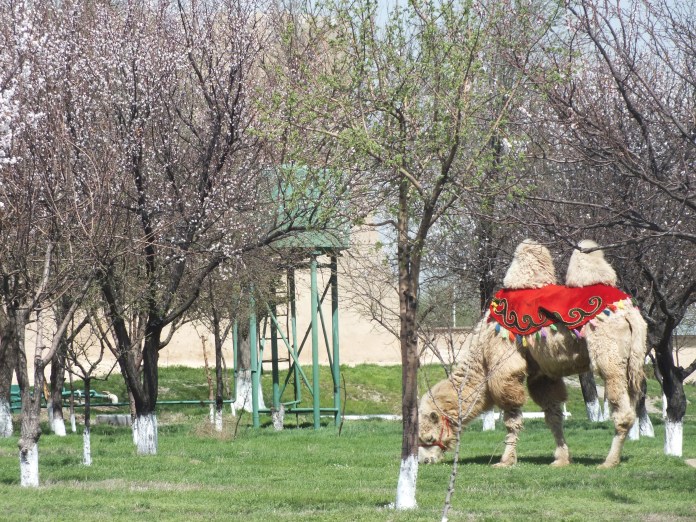
A camel sat on a carpet, waiting for tourists, but soon wandered off into the field of blossom. In the distance we could see the bright white mosque newly built by President Nazarbayev, glinting on the hazy horizon. In a canteen we found shubat (fermented camel’s milk) to drink, and then we hunted unsuccessfully through a hall of souvenir stalls, which was empty apart from a few stall owners hiding among their felt hats, miniature dombras and bracelets made of wolf claws.
On the bus back to our guesthouse, the conductor wanted to know what we were doing and where we were going. In between collecting bus fares, he would come back to us and resume a conversation through Google translate. It was a conversation often repeated, in restaurants, in the banya, on the train, with policemen, with printers, with shopkeepers: what are you doing in Kazakhstan? Tourists! Why do you want to come to Kazakhstan on holiday?! How much does it cost to come here? Where are you going? What are you doing? Are people friendly here?
The ethnic diversity of Kazakhstan is fascinating. Between all central Asian countries there has always been movement – Shymkent, for example, is the heart of Uzbek Kazakhstan – but Kazakhstan’s history makes it especially diverse. After the absorption of Kazakhstan into the Russian Empire and then the Soviet Union, it came to be known as a place of exile and forced labour. As well as the famous exiles such as Dostoevsky (who was interested in the ‘indigenous’ question in Kazakhstan) and Trotsky, thousands of people from North Korea to Ukraine were imprisoned in Kazakh gulags. Today, among populations of Russians, Koreans, Germans, Ukrainians, Belarusians, Uyghur, Chechens, Tartars and others, memories of this past are fading, or being deliberately ignored, and only the odd comment serves as a startling reminder.

In Shymkent we saw no trace of the wild west. The long Uzbek houses make parts of the town look like a village, with narrow streets through which men wander with trolleys, crying their wares. Drivers are astonishingly well behaved. We needed to print our train tickets, so we found a large copy centre where a group of young women and an old man sat. Walking into the room brought stares and the now familiar sensation of extreme self-consciousness, as though our mere presence would sustain conversation for the rest of the day. With much giggling they asked the usual questions (what are you doing in Kazakhstan! you came here on holiday?!), then refused to take payment, preferring payment in the form of English practice.
Another exchange took place in a canteen where we were having breakfast. We were approached by a kindly and distinguished looking gentleman who wanted to practise his English. Marat (like the Frenchman, he said, drawing a finger across his neck) was a wind power engineer who told us about his dream for Kazakhstan to be the largest producer of wind power. The more vodka he drank, the more enthusiastic he got about wind energy, and boasted that Kazakh wind turbines could be two and a half, later three, times more efficient than other countries. He’d won an innovation award in California and would be at Expo 2017 in Astana in the summer. I looked him up afterwards and he really had invented a wind turbine that was one and a half times more efficient than other types.
Marat told us that all Kazakhs must know their family members up to seven generations back, but that he could go twenty generations back. He insisted on getting more cake and tea, and taught us how to politely pour it out: the less full the cup, the more honoured the person is, and by the end we were pouring out thimblefulls to sip at every few minutes. He punched himself on his heart with pride every time he mentioned the word Kazakh. His greatest dream was not to build wind turbines or win prizes, but to retire and return to the heart of Kazakhstan, to live on the steppe with his horses, dogs and cows. For now, though, he could only wait for his lift to the windy plains of Otrar.





 Km. 0
Km. 0 